Key Points:
- In-home ABA therapy brings a trained therapist into your home, so your child practices skills where they actually live, play, and eat.
- Every session is designed and supervised by a BCBA, who writes the treatment plan and tracks your child’s progress.
- Most families in New Jersey find in-home ABA through a provider who serves their county — Go Grow ABA serves Essex County, including Montclair, Bloomfield, and Glen Ridge.
- NJ FamilyCare and many private plans cover in-home ABA therapy for eligible children.
- Go Grow ABA starts every family with a free consultation — call (732) 554-8383.
When you search for “in-home ABA therapy near me,” you are usually looking for something simple: a therapist who can come to your home and help your child. But behind that search are practical questions: what does a session look like, who is it for, how do you know the provider is good, and how do you find one serving your town in New Jersey?
This guide answers them: what in-home ABA therapy is, how a session works, who benefits most, and how to find a provider near you.
What In-Home ABA Therapy Actually Looks Like
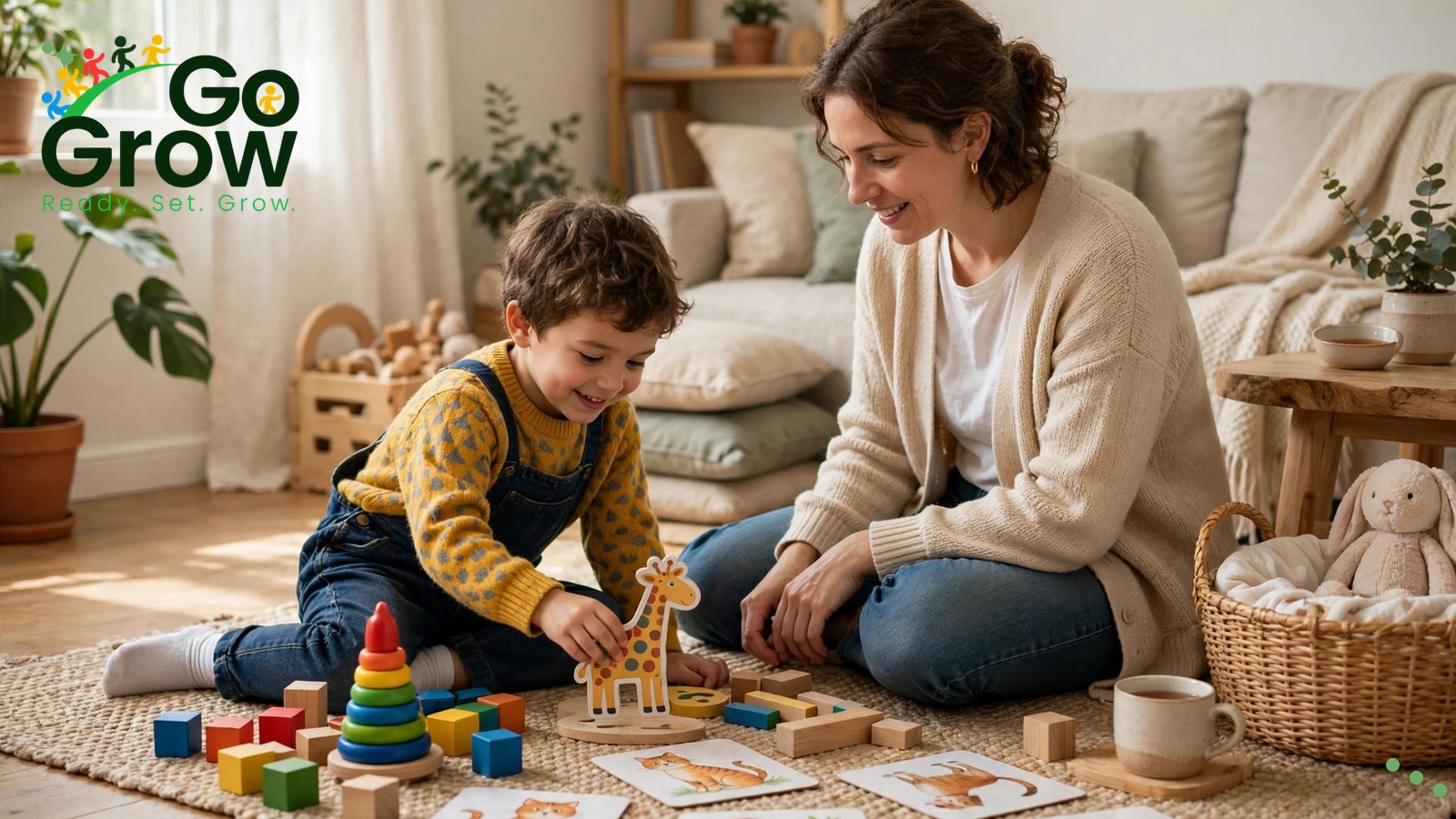
In-home ABA therapy is exactly what it sounds like: a trained therapist works with your child at home, instead of in a clinic or a school. The therapist arrives at a scheduled time and works on the goals in the plan — using the toys and routines your child already knows.
A session might start at the kitchen table with a matching game, move to the living room, and end with a routine like getting dressed. Because teaching happens where your child lives, the skills they practice are the ones they use every day.
The therapist is not a babysitter. Every activity is tied to a goal written by a BCBA — a Board Certified Behavior Analyst — and the therapist records data on how your child responds, so the BCBA can tell whether a goal is working. Our guide to what ABA therapy is covers the basics.
Who Benefits Most from In-Home ABA
In-home ABA works well for children who learn best in a familiar place. Young children, especially ages two to five, often settle faster at home than in a new building. Children who find busy places overwhelming focus better in their own living room. And teenagers working on daily living skills — cooking, getting ready — practice them where they actually do them.
It also works well for families. Parents can watch sessions and learn the same strategies the therapist uses, so teaching continues between sessions. Siblings can join in too. Our guide to ABA family therapy explains how the whole family takes part.
That said, in-home ABA is not the only setting. Some families use a mix — in-home sessions plus school services, or sessions after school. What matters is that the setting fits your child and your family, not a template.
How a Typical Session Works at Home
A typical session follows a rhythm, though the details depend on your child’s plan. The therapist arrives, greets your child, and spends a few minutes building rapport with a favorite toy or song. Real teaching starts once your child is comfortable — often faster than parents expect.
Sessions mix structured teaching and natural play — communication at the table, turn-taking with a game, then a self-care routine in the bathroom. Short breaks are built in, and the therapist follows your child’s lead.
At the end, the therapist gives a short update: what they worked on and what to practice next. The BCBA reviews the data regularly and adjusts the plan as your child progresses. Parent training usually starts early too, so you can use the same strategies between sessions.
What the BCBA Does (and Why It Matters)
The BCBA designs your child’s program. Before therapy begins, the BCBA carries out the ABA assessment — watching your child play, talking with you about their history and routines, and sometimes using structured activities to check specific skills.
From that assessment, the BCBA writes a treatment plan with goals, recommended hours, and how progress will be tracked. The BCBA supervises the therapist, reviews session data, and updates the plan when goals are met.
This is the most important thing to check: is the program designed and supervised by a BCBA? If a provider cannot tell you who their BCBA is, or how often the BCBA reviews the program, that is a warning sign. At Go Grow ABA, every program is BCBA-led, and families can ask the BCBA questions at any point.
How to Find In-Home ABA Therapy Near You in NJ
Search by county and town, not just by distance. A provider ten minutes away does not help if they do not serve your town — check the service area first, then ask about availability in your town.
Go Grow ABA provides in-home ABA therapy across Essex County — including ABA therapy in Montclair, NJ, ABA therapy in Bloomfield, NJ, and ABA therapy in Glen Ridge, NJ — as well as Nutley, Verona, Cedar Grove, and West Orange. Our page on ABA therapy in Essex County, NJ lists every town we serve.
To narrow the search, list providers who serve your town, check their programs are BCBA-led, and book a free consultation with one of them. The consultation is your chance to describe your child and judge how clearly the provider answers. Our guide to how to start ABA therapy in NJ walks through the whole process, from the first call to the first session.
Questions to Ask Before You Choose a Provider
Ask the same questions of each provider, so you can compare fairly:
- Who designs my child’s program, and how often does the BCBA supervise it?
- How many hours a week do you recommend, and why?
- Who will be my child’s therapist, and how do I reach the BCBA?
- How do you measure progress, and how often will you share it?
- How are parents involved — is there parent training?
- What does my insurance cover, and will you verify my benefits first?
- How long is the wait to begin?
A good provider answers clearly, in plain language. If the answers are vague, or you are pressured to decide on the spot, take your time — choosing a provider affects your child every week, and it deserves a careful look.
How In-Home Therapy Fits Around School and Daily Life
Most families fit sessions around the school day. Many children have sessions after school, when the therapist can work on homework, play skills, and goals the school day does not cover. Younger children not yet in school often have sessions during the day.
In-home therapy also fits around family life in a way clinic therapy cannot. Sessions happen in your home — no drive, no waiting room. Siblings can be nearby, routines carry on, and the therapist sees your child in their real daily life, where the goals matter most.
It can also run alongside school services. After age three, the district evaluates your child and may provide services through an IEP, and private sessions can cover goals the school day does not. Our guide to after school ABA therapy near me in NJ explains how families combine the two.
What In-Home ABA Costs in NJ
Cost is the question every family asks, and the honest answer is that it depends on your insurance coverage and the hours your child needs. In New Jersey, NJ FamilyCare — the state’s Medicaid program — covers ABA therapy for eligible children, and many private plans cover it too.
A good provider handles insurance verification for you before therapy begins, and explains the result in plain language: what is covered, whether a prior authorization is needed, and what you will pay, if anything. Many families pay little or nothing out of pocket when their plan covers ABA therapy — ask for a written estimate after the check. Our guide to insurance coverage for ABA therapy in NJ answers the common questions, and our guide to affordable ABA therapy near me in NJ explains how families manage costs.
How Go Grow ABA Works
Go Grow ABA provides BCBA-led in-home ABA therapy in New Jersey for children ages 2–21 across Essex County. Every family starts with a free consultation — a conversation, not a test — where you describe your child and we explain whether in-home ABA fits.
After the consultation, a BCBA assesses your child and writes the plan, and therapy begins at home, on your family’s schedule. Parents are involved from the start, with training and regular updates.
To see how we work before you call, read more about us or book a parent tour application first. Or start today: call (732) 554-8383 or reach out through our contact us page.
Frequently Asked Questions
How do I find in-home ABA therapy near me in NJ?
Search by county and town, and check that the provider serves your area. Go Grow ABA serves Montclair, Bloomfield, Glen Ridge, Nutley, Verona, Cedar Grove, and West Orange in Essex County. Book a free consultation with a provider who serves your town, and ask who designs the program and how soon therapy can start.
What happens during an in-home ABA session?
A trained therapist comes to your home and works on the goals in your child’s treatment plan, using play, routines, and everyday activities — for example, practicing communication at the kitchen table or a self-care routine in the bathroom. The therapist records data on how your child responds, and the BCBA reviews that data to adjust the plan. The session usually ends with a short update for you.
How many hours of in-home ABA therapy does my child need?
It depends on your child. The BCBA recommends the number of hours after the assessment, based on your child’s needs and goals. There is no fixed number that fits every child, and the hours can change as your child makes progress. Ask the provider to explain the recommendation in plain language before you agree to it.
Does insurance cover in-home ABA therapy in NJ?
In most cases, yes. NJ FamilyCare covers ABA therapy for eligible children, and many private plans cover it too. Your provider should verify your coverage before therapy begins and tell you what is covered and what you will pay, if anything.
Is in-home ABA therapy different from center-based ABA?
The setting is different, but the therapy is the same kind of care: a BCBA designs the program and a trained therapist delivers it. In-home ABA takes place in your house, so skills are practiced where your child actually uses them. Center-based ABA takes place in a clinic. Our comparison of center-based ABA vs. in-home ABA explains the differences in full, so you can judge which setting fits your family.
What should I have ready before the first session?
Gather any diagnosis paperwork or evaluation reports, your insurance card, and a short note about your child’s strengths, challenges, and daily routine. Set aside a space in your home where sessions can happen, and keep a few of your child’s favorite toys nearby. You do not need everything perfect before you call — a good provider will tell you exactly what is missing.