
Key Points:
- ABA therapy cost in NJ involves separate provider charges, insurance payments, and family expenses.
- Covered in-network bills generally use the plan’s allowed amount, with deductibles, copays, or coinsurance determining the family’s share.
- Annual estimates need stated assumptions about rates, hours, weeks of care, and separately billed services.
ABA therapy cost in NJ depends on the services a child receives, the provider’s prices, and the family’s insurance benefits. An hourly charge alone does not show what a parent will owe.
A written estimate helps connect those numbers to the household budget. At Go Grow ABA, we check insurance benefits as part of getting started, so families can understand their coverage before planning care.
 Provider Charges, Insurance Payments, and Family Costs
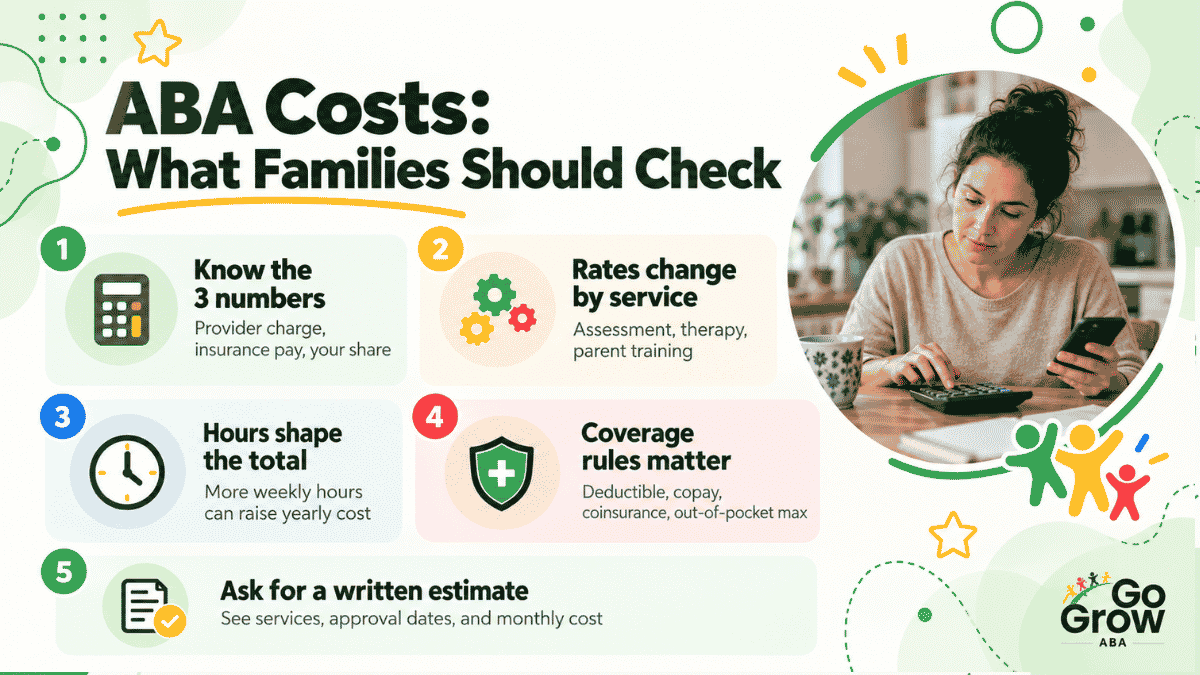
ABA billing involves several amounts. A provider’s charge, the insurer’s allowed amount, and the family’s share can differ.
| Billing Term | What It Means |
|---|---|
| Billed charge | The amount the provider submits to insurance. |
| Allowed amount | The amount the plan recognizes for a covered service. An in-network contract usually sets this amount. |
| Insurance payment | The portion the insurer pays after applying the plan’s benefits. |
| Family responsibility | The deductible, copay, coinsurance, or other charges the family owes under the applicable rules. |
The allowed amount includes both the insurer’s payment and any required family share. It is not automatically the amount insurance pays.
For example, a hypothetical covered, in-network service might have:
- A billed charge of $150.
- An allowed amount of $100.
- A family coinsurance share of 20%, after the deductible.
- An insurance payment of $80 and a family payment of $20.
In this example, the provider accepts $100 total under its network agreement. The remaining $50 is a contractual adjustment. Out-of-network billing can work differently.
Hourly Rates Depend on the Service
ABA care can include an assessment, direct treatment, and caregiver sessions. A quote should identify the service, its price, and whether the provider bills by the hour or another time unit.
A family comparing prices can request separate estimates for:
- The initial assessment and later reassessments.
- Direct therapy sessions.
- Analyst-delivered treatment or changes to treatment procedures.
- Caregiver training.
Our ABA assessments include a BCBA-led evaluation, a written report, treatment recommendations, and insurance documentation support. We also provide parent training that helps caregivers use strategies during home routines. Each service’s coverage and expected family cost deserve a separate check.
A Sample Annual Cost Calculation
Annual ABA therapy costs depend on the actual rate, hours delivered, and weeks of care.
The following example uses an invented $100 hourly self-pay rate to show the calculation. It is not a New Jersey average or a Go Grow ABA quote.
| Weekly Direct Therapy | Calculation | Annual Direct-Therapy Total |
|---|---|---|
| 10 hours | $100 × 10 hours × 52 weeks | $52,000 |
| 20 hours | $100 × 20 hours × 52 weeks | $104,000 |
Both examples assume the same rate and schedule for 52 weeks, with every planned hour delivered and billed. They exclude assessments, caregiver sessions, other separately billed services, and insurance payments.
A child’s recommended schedule should come from an individual assessment. Our explanation of ABA therapy hours per week covers the factors behind those recommendations.
Does Insurance Cover ABA Therapy in New Jersey?
Many New Jersey health plans cover medically necessary ABA for autism, but coverage does not mean every family pays the same amount.
Fully insured plans regulated by New Jersey must follow applicable state autism coverage requirements. Self-funded employer plans generally fall outside the state mandate, although they may cover ABA and remain subject to applicable federal requirements. The plan documents determine the available benefits.
NJ FamilyCare also provides an ABA benefit for eligible members with autism under age 21. Medical need, provider participation, and authorization requirements still apply. Our article on ABA coverage under NJ FamilyCare explains that program in more detail.
For private insurance, several terms affect the household budget:
- Deductible: The amount the family pays for certain covered services before the plan starts sharing those costs.
- Copay: A fixed payment for a covered service.
- Coinsurance: A percentage of the allowed amount.
- Out-of-pocket maximum: The plan-year limit on qualifying payments for covered, in-network care.
The out-of-pocket maximum generally excludes premiums, noncovered services, and out-of-network expenses. A family should check both individual and family limits, along with the date those amounts reset.
 What Should a Written ABA Cost Estimate Include?
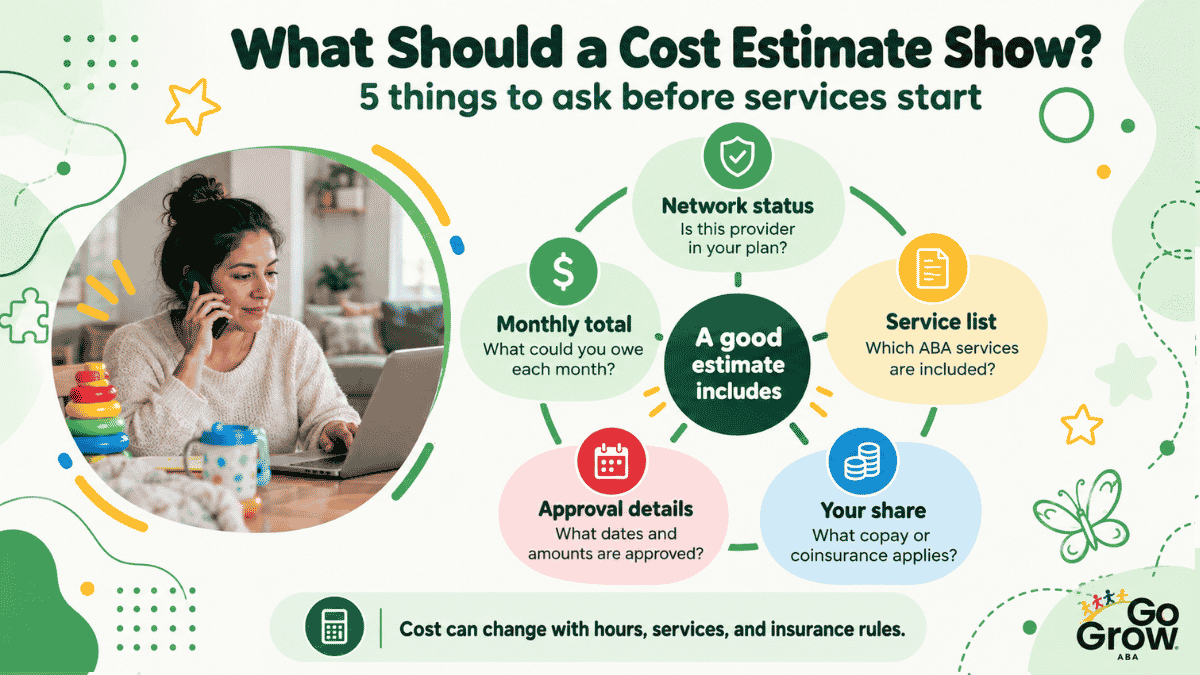
An ABA cost estimate should identify the planned services, insurance assumptions, and expected family payments. A benefits check or authorization is not a guarantee that insurance will pay every claim.
The provider and insurer can help answer these questions:
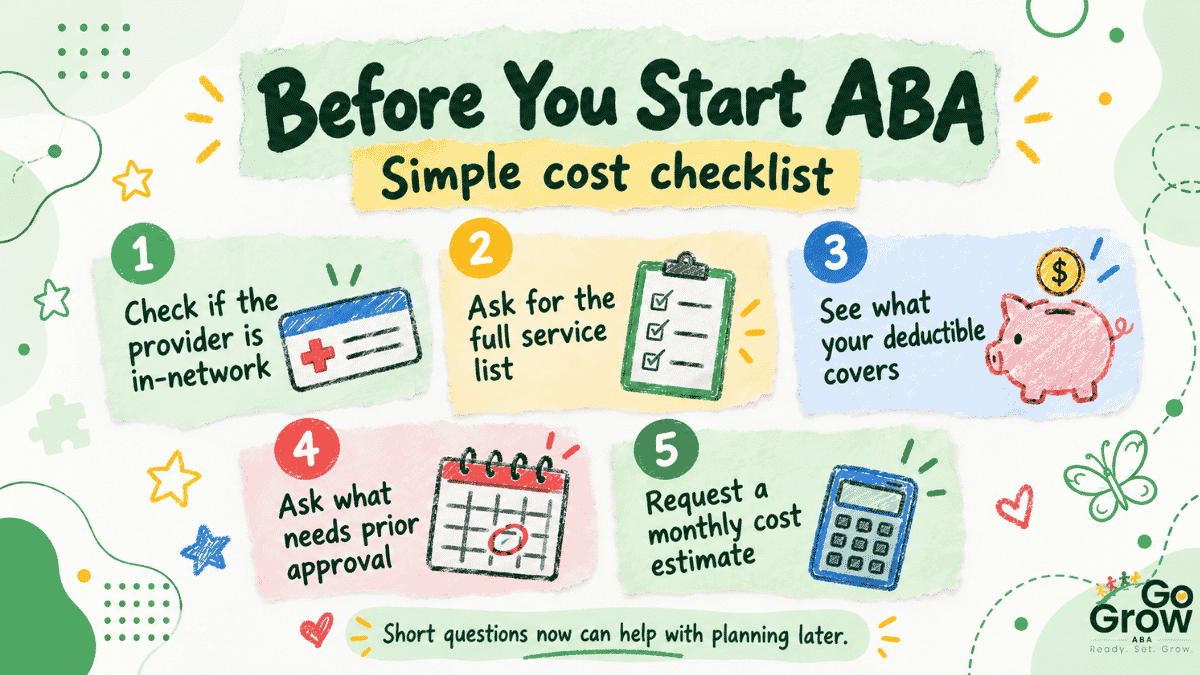
- What is the provider’s network status under this exact plan?
- Which services, billing codes, and time units does the estimate include?
- What deductible remains, and what copay or coinsurance applies?
- Which services require prior authorization, and what dates and amounts does approval cover?
- What could the family owe for the assessment and a typical month of treatment?
- Which charges could fall outside insurance benefits?
A monthly estimate can be easier to budget around than a large annual total. Any estimate should also explain what could change it, such as different hours, a renewed authorization, or a new insurance plan.
For families paying without insurance, federal rules generally require a good faith estimate of expected charges when requested or when care is scheduled at least three business days ahead.
Financial Resources for Uncovered Expenses
New Jersey’s Catastrophic Illness in Children Relief Fund may reimburse qualifying medical expenses that insurance and other sources do not cover.
Eligibility includes residency, age, and expense requirements. Eligible expenses during a consecutive 12-month period must exceed 10% of the first $100,000 of family income, plus 15% of income above that amount. The child must have been younger than 22 when the expenses occurred. An application does not guarantee payment for ABA or any particular bill. nj.gov
Families facing coverage problems can also use Autism New Jersey’s insurance resources to understand plan types and coverage concerns. Insurance assistance and financial reimbursement serve different purposes; a referral or recreation program does not necessarily fund therapy.
 FAQs About ABA Therapy Costs in NJ
Is an explanation of benefits a bill?
An explanation of benefits, or EOB, is an insurance statement, not a payment request. It shows provider charges, allowed charges, insurance payments, and the patient balance. A family can compare the provider’s bill with the EOB’s payment details, accounting for payments already made.
Can an HSA or FSA pay for ABA expenses?
Eligible medical treatment expenses may qualify for payment through a health savings account or flexible spending arrangement. The IRS rules for therapy expenses distinguish medical treatment from general wellness services. The account administrator can explain documentation requirements and which unreimbursed expenses qualify.
What happens if insurance denies ABA coverage?
A denial may allow an appeal. The denial notice should explain the reason and applicable deadlines. Families can request a review with supporting records from the treating provider. New Jersey outlines appeal rights for plans under its managed care law. Other plan types follow different procedures.
Review ABA Costs Before Services Begin
ABA expenses become easier to plan when the estimate connects each service to its coverage and expected family payment. That gives the household a practical starting point for budgeting around care.
At Go Grow ABA, we offer in-home ABA therapy, assessments, and caregiver training in New Jersey. Our team can check benefits and talk through your child’s needs during a free consultation.