Key Points
- Learning how to prepare for in-home ABA therapy is mostly about clearing a calm space and agreeing on a routine — not buying special equipment or rebuilding a room.
- One small, low-distraction corner with a table, two chairs, and your child’s favorite toys is enough to start; the BCBA will tell you what else is needed after the assessment.
- Tell the whole household the plan: when sessions happen, who is in the room, and what siblings and pets do during that time — consistency is what makes therapy work.
- Your job as a parent is to be available, to watch, and to learn the prompts your child’s therapist uses — ABA parent training shows you how.
- Go Grow ABA provides BCBA-led, in-home ABA therapy across Montclair and Essex County for children ages 2–21 — call (732) 554-8383 for a free consultation.
When therapy is about to start in your own living room, it is natural to wonder whether your home is ready. Do you need a special room? Special toys? A schedule printed on the wall? The honest answer is simpler than most parents expect: a calm corner, a few familiar things, and a household that knows the plan are enough. The BCBA — the Board Certified Behavior Analyst who designs your child’s program — will tell you exactly what else is needed after the assessment, and most of it is already in your house.
Start With a Conversation, Not a Shopping List
Before you buy anything, talk to the BCBA. The assessment comes first: the BCBA watches your child at home, talks with you about routines and challenges, and writes a plan with goals matched to your child. Only then does it make sense to gather materials, because the right materials depend on the goals — a child working on requesting needs favorite snacks and toys within reach, while a child working on self-care needs the real toothbrush and the real shoes.
If you are still at the stage of choosing a provider, our guide to how to start ABA therapy in NJ walks through the first steps, and our guide to how to choose an ABA therapist in NJ explains what to look for. If your child has just received a diagnosis, our guide to ABA therapy after an autism diagnosis in NJ explains what to do next. And if you want to know what sessions actually look like, our guide to what to expect from in-home ABA therapy in NJ describes a typical session.
Choose One Calm Space
Pick one spot in the house where sessions will usually happen, and keep it as consistent as you can. It does not need to be a separate room — a corner of the living room or a quiet end of the kitchen table works well. What matters is that it is the same place most days, so your child knows that this spot means learning time.
Look for a spot with as few distractions as possible: away from the television, away from the front door, and out of the path of people walking through. If the room has a window onto a busy street, a curtain helps. If the room is shared with siblings’ toys, a low shelf or a couple of bins can hold the session materials apart from the rest.
A Small Table, Two Chairs, and a Few Basics
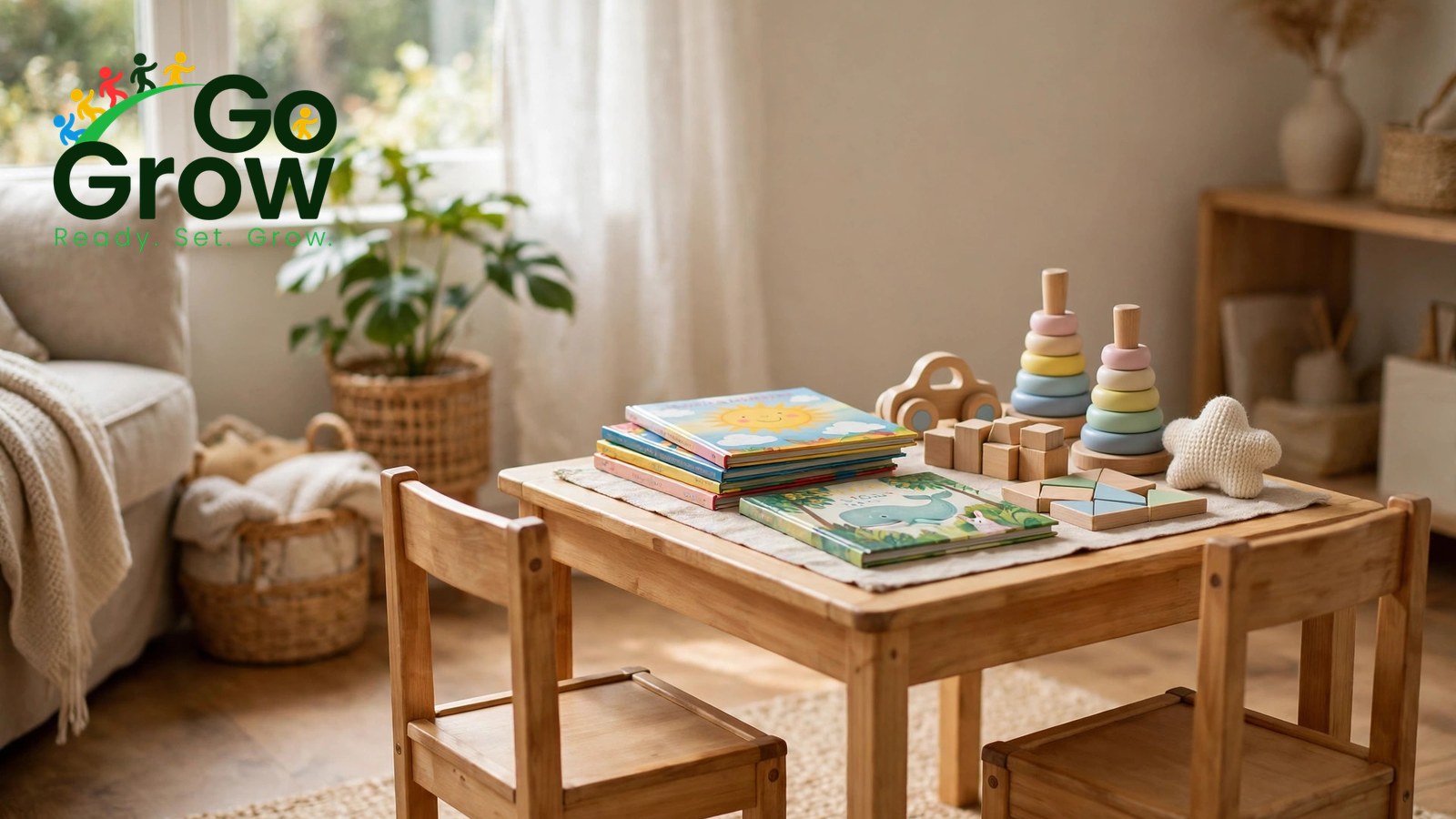
Most in-home ABA therapy needs very little furniture: a child-sized table or a clear stretch of a regular table, a chair for your child, and a chair for the therapist. If your child works better on the floor, a rug or a mat works just as well — the BCBA will tell you what fits your child’s plan.
Beyond furniture, a short list of basics covers most first weeks: paper and crayons, a few picture cards if the BCBA provides them, a timer (a phone timer works), and a small box or shelf where session materials live between visits. Keep the materials in one place so the therapist does not spend the first ten minutes of a session searching. A simple notebook helps too — a place to jot down what happened, what worked, and any questions for the BCBA.
Gather the Toys and Materials Your Child Already Loves
The most useful preparation is also the easiest: gather the things your child already loves and put them where the therapist can reach them. In ABA therapy, favorite toys, snacks, and activities are the rewards that make learning worth the effort — and nobody knows what your child loves better than you do.
Make a simple list: the three toys your child reaches for first, the snack they ask for most, the activity that always gets a smile. Tell the therapist on the first day. It saves a week of guessing and lets the first sessions start with success instead of trial and error. If your child has a comfort object — a blanket, a stuffed animal — keep it nearby, not locked away; comfort is part of learning, not a distraction from it.
Plan the Routine Around Real Life
Therapy works best when it fits your family’s real day, not the other way round. Before the first session, think about when your child is at their best — after a nap, after breakfast, before the afternoon slump — and say so when scheduling. A tired or hungry child learns less, and a session timed right is worth more than a session squeezed in.
Build the session into the day visibly. A simple visual schedule — a few pictures in a row showing breakfast, therapy, play, lunch — helps many children with autism know what is coming and reduces anxiety about the change. Your BCBA can help you make one, and it can live on the fridge or the wall of the therapy corner.
Siblings, Pets, and the Rest of the Household
A house is not a clinic, and in-home ABA therapy has to work with the household you actually have. Tell the BCBA about siblings and pets before the first session, and agree on a plan together.
For siblings, the usual plan is simple: during session time, siblings play elsewhere, with something enjoyable of their own. It helps to explain to them in advance that the therapist is coming to play learning games with their brother or sister, and that their turn for a game comes after. Older siblings can sometimes join a short activity at the end of a session — with the BCBA’s agreement — which builds the social skills ABA therapy targets. Our guide to ABA family therapy looks at how therapy supports the whole household.
What to Do in the First Week
The first week is about settling in, not about results. Expect the therapist to spend time playing with your child, learning what they like, and building trust before any formal teaching begins. This is not wasted time — a child who likes their therapist will work harder for them, and a child who feels safe will try new things.
Your job in the first week is to be nearby, watch, and ask questions. Watch how the therapist gives instructions, how they praise success, and what they do when your child gets stuck. Try using the same words yourself between sessions — consistency between the therapist and the family is the single biggest factor in how fast a child progresses. The BCBA will review the data from the first sessions and adjust the plan; our intake checklist for starting ABA therapy in NJ lists what to have ready before the first visit.
Getting Started in Montclair and Essex County
If you have not started yet, the first step is a free consultation: you describe your child, your home, and your schedule, and the provider explains how in-home ABA therapy would work for your family. After that, a BCBA carries out the assessment, writes the plan, and therapy begins at home — in the corner you have already picked out.
For children under three, there is a separate route worth knowing: NJEIS, New Jersey’s early intervention program, provides a free evaluation, and services can begin before a formal autism diagnosis. After age three, the school district evaluates through an IEP. Our guide to early intervention ABA therapy explains the under-three route.
Go Grow ABA provides BCBA-led, in-home ABA therapy across Montclair and Essex County — Bloomfield, Glen Ridge, Nutley, Verona, Cedar Grove, and West Orange — for children ages 2–21. Our guide to ABA therapy in Montclair, NJ covers the town in detail, and our guide to ABA therapy in Essex County, NJ lists every town we serve.
Book a free consultation by calling (732) 554-8383 or reaching out through our contact us page. You can also read more about us, or book a parent tour application to see how we work before you call. If you want to know who will be working with your child, our guide to ABA therapy team roles introduces the people on a typical team, and our guide to common ABA therapy questions in NJ answers the questions most families ask first.
Frequently Asked Questions
How do I prepare my home for in-home ABA therapy?
Pick one calm, low-distraction spot and keep it consistent, with a small table and two chairs or a floor mat. Gather your child’s favorite toys and snacks, keep session materials in one place, and agree on a routine for when sessions happen and who is in the room. The BCBA will tell you what else is needed after the assessment — most families already own nearly everything required.
Do I need to buy special equipment or toys?
Usually not. Most in-home ABA therapy needs only a table, chairs, paper and crayons, and the toys and snacks your child already loves. The BCBA recommends specific items once your child’s goals are set. The most useful preparation is a list of your child’s favorite things — favorite toys, snacks, and activities — which the therapist uses as rewards.
Where in the house should ABA therapy sessions happen?
In one consistent, calm spot — a corner of the living room or a quiet end of the kitchen table works well. It should be away from the television and the front door, and out of the path of people walking through. It does not need to be a separate room, and it should feel familiar and safe to your child, not sterile.
Should parents be present during in-home ABA therapy?
Yes — parents are usually nearby and available, watch parts of the session, and learn the prompts and reinforcement the therapist uses. ABA parent training teaches you how to use the same techniques between sessions, and that consistency is the biggest factor in how fast your child progresses. Your BCBA will agree with you on exactly how involved you are in each session.
What about siblings and pets during sessions?
Agree on a plan with the BCBA before the first session. Siblings usually play elsewhere during session time, with something enjoyable of their own, and older siblings can sometimes join a short activity at the end. A calm pet your child loves can stay if it does not interrupt; an excitable pet is usually better in another room during sessions.
How long before we see progress from in-home ABA therapy?
It varies by child and by goal, but many families see small changes within the first weeks — a new word, a longer turn at play, a smoother transition — and bigger changes over months. The BCBA records data every session and reviews it regularly, adjusting the plan when progress stalls. Consistency at home, through parent training, makes the biggest difference to speed.