

Key Points:
- DTT vs NET describes two ways to arrange ABA instruction: separate teaching rounds and practice within everyday activities.
- A treatment plan may include either format or both, without requiring a fixed balance in every session.
- The clinical team uses assessment findings, child and family preferences, and progress data to select teaching methods.
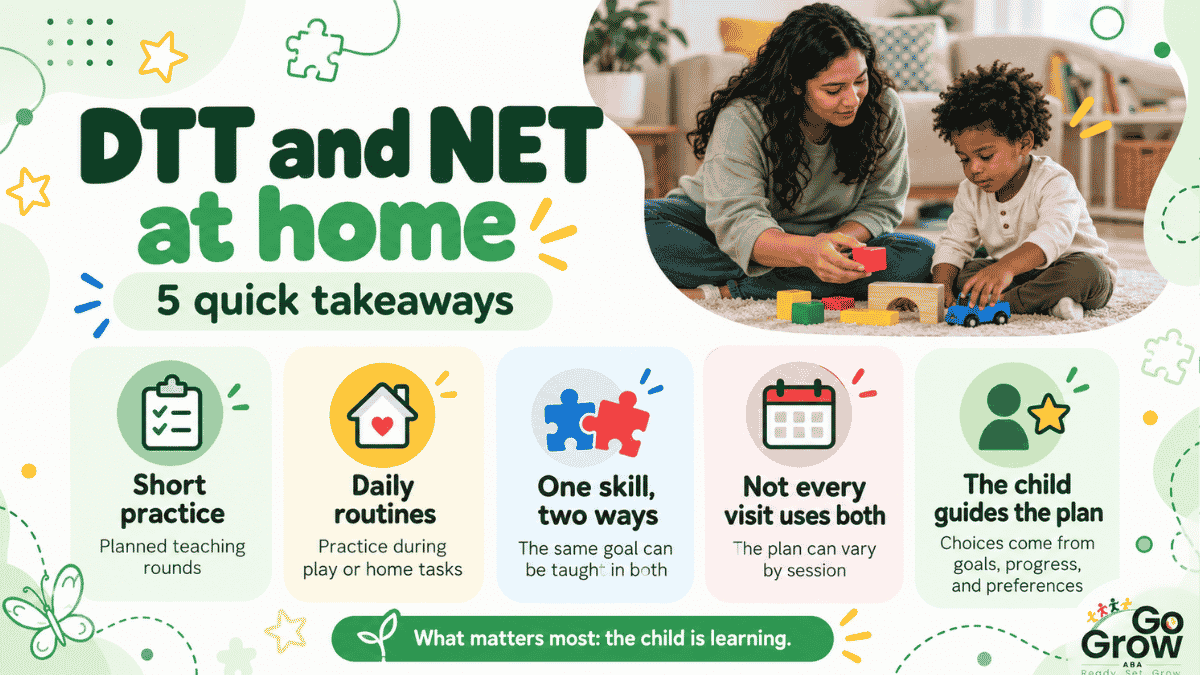
DTT and NET are two ABA therapy techniques that organize learning differently. Discrete trial training (DTT) uses short teaching rounds. Natural environment teaching (NET) builds practice into play and daily routines.
A home session may include one format or both, depending on the child’s treatment plan. Neither method belongs in every visit. Understanding the difference helps you recognize what your child is practicing and why.
 What Does Discrete Trial Training Look Like?
DTT gives a child repeated opportunities to practice a specific skill. Each teaching round has a defined beginning and end. The therapist presents an instruction, watches the response, and provides feedback before the next round. Vanderbilt University’s IRIS Center describes this instruction-response-feedback sequence.
A round generally includes:
- An instruction or cue: The therapist presents a task.
- The child’s response: The child responds, with a prompt if the plan calls for help.
- Feedback: A correct response receives reinforcement, such as praise or access to a preferred activity. An incorrect response receives support according to the teaching plan.
- A short pause: The therapist prepares the next opportunity.
DTT does not require a desk or flashcards. A therapist can arrange structured practice with toys on the floor. The defining feature is the teaching sequence, not the furniture. UNC’s DTT practice resource explains how teams plan, carry out, and monitor this instruction.
Natural Environment Teaching Builds Practice Into Daily Activities
NET uses a child’s interests and everyday activities to create teaching opportunities. A therapist may join a game, support a household routine, or arrange materials that invite the child to communicate or participate.
The activity can look like play, but the therapist still works toward a defined goal and records responses. Reinforcement often comes from the activity itself. For example, a child who requests another turn gets another turn in the game. UNC’s naturalistic intervention resource explains this planned teaching within everyday routines.
At Go Grow ABA, our in-home ABA therapy includes natural environment teaching within daily routines, individualized goals, and caregiver involvement. Home activities give us a setting for practicing skills that families use during the day.
DTT vs NET at a Glance
The main difference concerns how the therapist arranges practice. Both formats can include prompts, reinforcement, and progress tracking.
| Feature | DTT | NET |
|---|---|---|
| Starting point | A planned instruction or task | A child’s interest or an everyday activity |
| Teaching structure | Separate rounds with a beginning and end | Opportunities within an ongoing activity |
| Reinforcement | A planned consequence after the response | Often the natural result of participating |
| Materials | Selected items, which may include ordinary toys | Materials connected to the activity |
| Progress tracking | Responses during teaching rounds | Responses during planned opportunities in the routine |
The same toy can appear in either format. A toy car does not automatically make an activity NET, just as sitting at a table does not automatically make it DTT.
 One Skill Can Receive Different Kinds of Practice
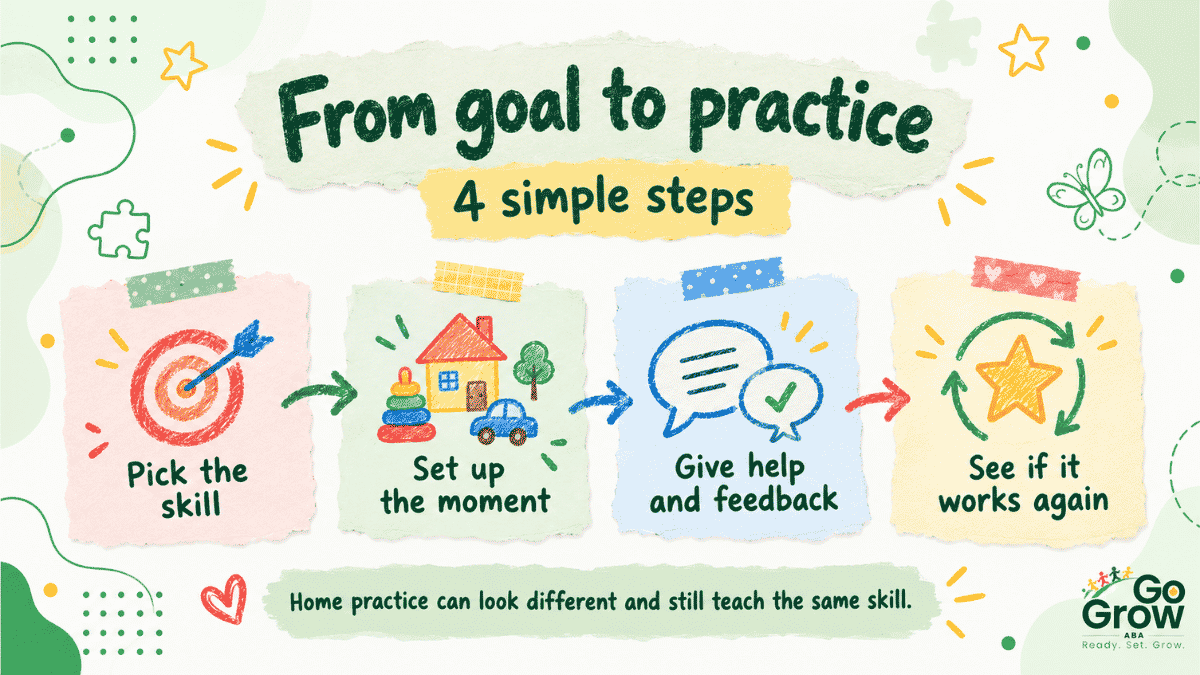
A hypothetical example shows how the formats can address the same goal. Suppose a child is learning to identify red objects:
- During DTT: A therapist presents two blocks and says, “Touch red.” The child responds, receives feedback, and gets another planned opportunity.
- During NET: While the child enjoys building a toy garage, the therapist asks for the red car to park inside. Practice happens within the game.
The team may also check whether the child recognizes red with different objects or people. That process, called generalization, examines whether learning extends beyond the original practice. Changing activities alone does not establish that the child has learned the skill.
A session does not need to follow this sequence. Some goals may receive naturalistic teaching from the beginning.
How Does the BCBA Choose Between DTT and NET?
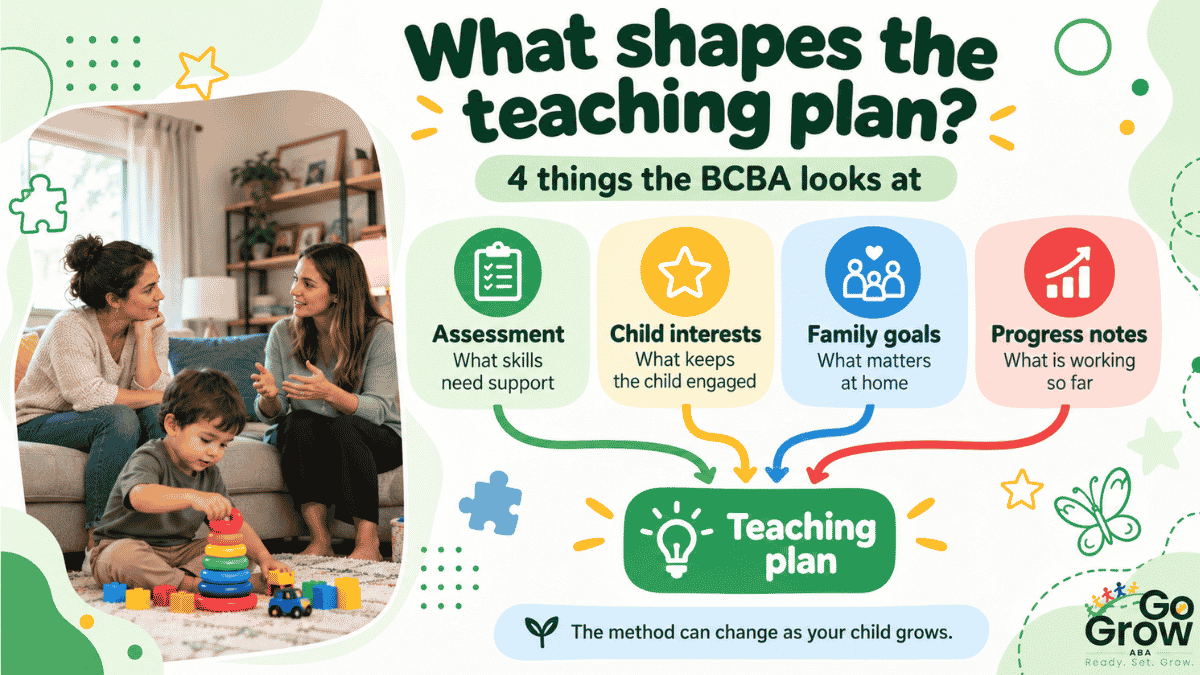
A Board Certified Behavior Analyst (BCBA) considers assessment results, the child’s needs and preferences, family priorities, and progress data when choosing teaching methods. Neither label establishes which approach will work better for an individual child.
The BACB’s treatment-selection standards require behavior analysts to base interventions on evidence and assessment findings, consider preferences, and use data to evaluate the plan.
Our BCBA-led ABA assessments include observation, caregiver input, and skill assessment to inform treatment recommendations. That information helps connect teaching decisions to what a child needs to learn.
Questions That Help Families Understand the Teaching Plan
Families can request an explanation tied to a specific goal. Questions such as these keep the conversation practical:
- Which skill are these teaching rounds addressing?
- Why did you choose this activity for practice?
- What counts as an independent response?
- How will you reduce help as my child learns?
- What would lead you to change the teaching approach?
Through our ABA parent training, we explain strategies and support caregivers as they apply them during home routines. You do not need to learn every technical term to take part in your child’s care.
For a broader explanation of a visit, our home ABA session walkthrough covers arrival, activities, caregiver involvement, and the end of the session.
 FAQs About DTT and NET
Does my child need to speak before learning through DTT or NET?
Spoken answers are not required for every goal. A response might involve pointing, matching objects, or completing an action. Communication goals should reflect the child’s abilities and communication methods.
Can schools use DTT and NET too?
Both formats can support teaching outside the home, including educational settings. Their use depends on the learner’s goals and the plan for that setting. A school’s teaching arrangements may differ from home therapy.
What happens if my child becomes upset during practice?
Distress calls for attention to the child’s needs. The therapist should consider what is happening, respond to communication, and involve the BCBA when changes are needed. Professional standards emphasize dignity, minimizing harm, and obtaining the child’s assent when applicable.
Explore Teaching Options for Your Child’s Home Sessions
DTT offers focused practice, while NET places learning within familiar activities. A child’s goals, participation, and progress should shape how the team uses either format.
At Go Grow ABA, we provide individualized home therapy, ABA assessments, and caregiver support. Our team can talk through your concerns and explain the steps involved in starting services.