
Key Points:
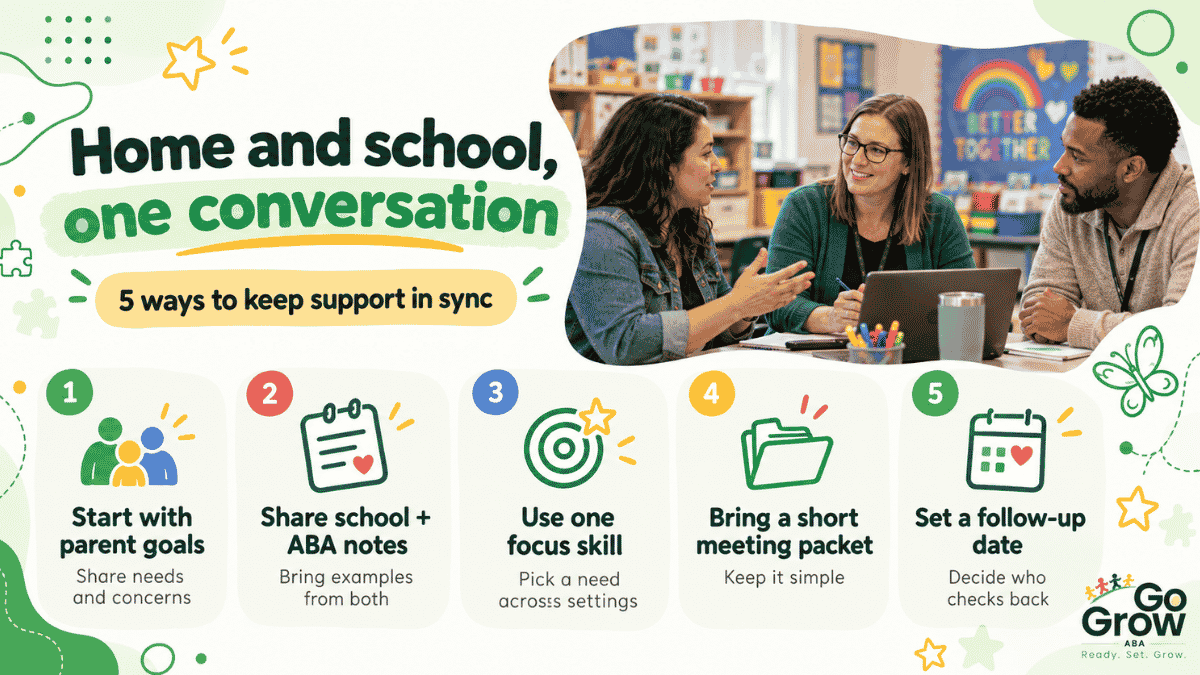
- ABA therapy and IEP coordination starts with a parent-approved exchange of goals, classroom observations, and treatment data.
- Parents participate in school decisions, while private BCBAs contribute clinical recommendations without controlling district services.
- New Jersey and Colorado evaluation deadlines cover different stages, so families should track consent dates and the steps due.
ABA therapy and an Individualized Education Program (IEP) can support different parts of your child’s day. The school plan addresses learning and school participation. Private ABA focuses on individual treatment needs.
A child might request help during therapy but need more support doing so in a busy classroom. Communication between teams helps everyone compare what happens in each setting and decide which supports to consider.
 Does an IEP Include ABA Therapy?
An IEP can include ABA-based instruction or behavioral services when the IEP team determines those supports are necessary for the child’s education. An autism diagnosis or private BCBA recommendation does not automatically establish a particular school service.
The Individuals with Disabilities Education Act (IDEA) requires IEP teams to consider positive behavioral interventions and supports when behavior interferes with the child’s learning or other students’ learning. That requirement does not prescribe ABA for every child.
Private ABA follows a separate treatment plan and funding process. School decisions do not replace the clinical and coverage decisions involved in private care.
School and Private ABA Team Responsibilities
Parents participate in IEP decisions alongside school professionals. The district remains responsible for providing the services in the IEP; a private provider does not take over that duty.
| Team Member | Main Responsibility |
|---|---|
| Parent or caregiver | Shares priorities, observations, and concerns; participates in school decisions. |
| Teachers and school specialists | Describe classroom needs, contribute evaluation information, and carry out assigned school supports. |
| District representative | Contributes knowledge of school resources and helps develop the educational program. |
| Private BCBA | Oversees the private ABA treatment plan and contributes clinical information when invited and authorized. |
The required IEP team members include parents, relevant teachers, a district representative, and someone who can explain evaluation results. The child participates when appropriate.
Our explanation of ABA therapy team roles covers responsibilities within the private treatment team.
Can a Private BCBA Attend an IEP Meeting?
Parents may invite a private Board Certified Behavior Analyst (BCBA) who has knowledge or special expertise about their child. IDEA permits parents to invite such individuals as additional IEP team participants.
The school contact should receive the clinician’s name before the meeting. Families can also check the BCBA’s availability and any charges for participation.
Before direct information sharing, the school and provider should address the written permissions needed. A release should identify the records, recipients, and purpose. Meeting participation does not automatically arrange classroom visits or direct therapy at school.
A Short Packet for the IEP Meeting
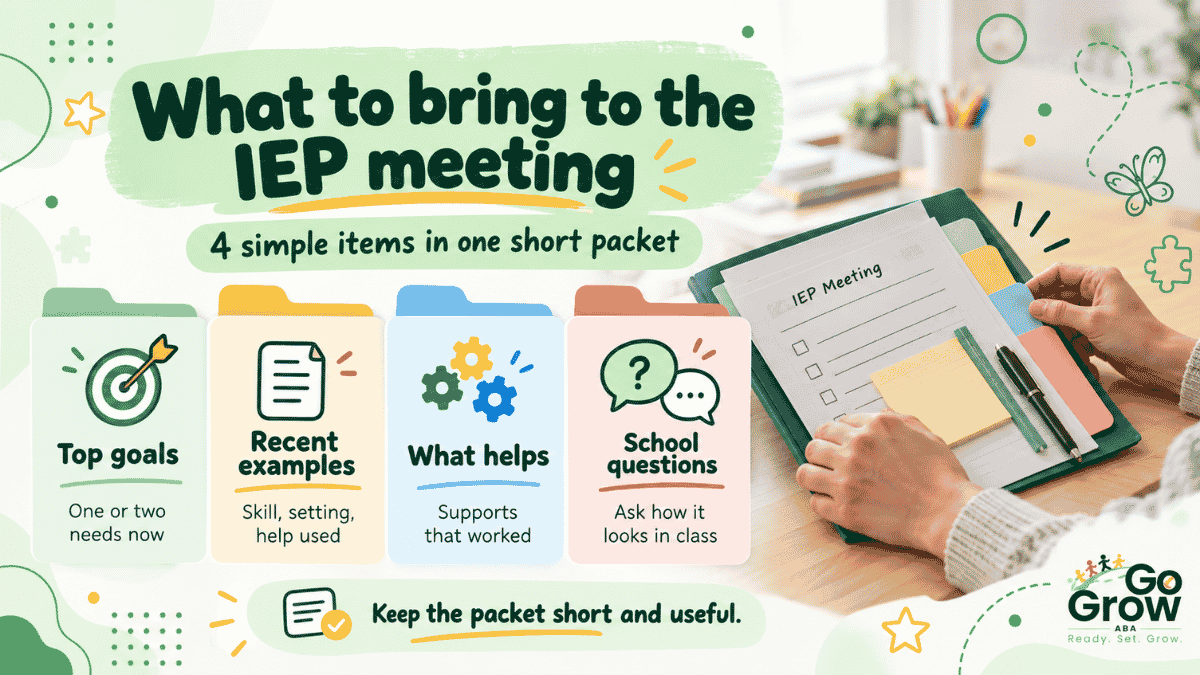
A focused summary gives the team information it can discuss during the meeting. Families can request:
- One or two current treatment priorities.
- Recent data showing the skill, setting, and help provided.
- Supports that have helped during therapy.
- Questions about how the same concern appears at school.
Classroom observations belong beside therapy data. A skill used during a quiet home activity may look different during group instruction.
At Go Grow ABA, our BCBA-led ABA assessments use observation, caregiver input, and assessment tools to develop treatment recommendations. Our written report supports treatment planning; it does not replace the school’s special education evaluation or an autism diagnostic evaluation.
Families comparing the wording in both plans can also read about setting ABA therapy goals.
 One Skill Across Home and School
The teams can discuss a shared need without copying every goal or teaching step.
For a hypothetical example, a child might need help communicating when an activity becomes difficult:
| Setting | Possible Focus |
|---|---|
| Private ABA | Practicing a help request during a home activity. |
| School | Using a help request during classroom work. |
| Team discussion | Comparing how the child communicates, what help adults provide, and how adults respond. |
A picture card might work during one activity, while words or a communication device work during another. The discussion should include the child’s communication preferences and signs of discomfort.
We include school and community collaboration among our supports. A Trenton school counselor’s published testimonial describes working closely with our team on a student’s classroom routines. That feedback describes one student’s experience.
Our parent training also helps caregivers practice strategies during home routines. School staff remain responsible for implementing school supports.
New Jersey and Colorado Evaluation Deadlines
Initial evaluation deadlines apply to the formal special education process. They do not set deadlines for routine conversations between a school and a private therapist.
| State | General Initial Timeline |
|---|---|
| New Jersey | Within 90 calendar days after receiving parental consent, the district must complete evaluation, determine eligibility, and, if the child qualifies, develop and implement the IEP. |
| Colorado | The initial evaluation must finish within 60 calendar days after the formal referral process begins with written parental consent. The initial IEP must be developed within 90 calendar days of evaluation consent for an eligible child. |
New Jersey’s deadline appears in N.J.A.C. 6A:14-3.4(e). Colorado’s deadlines appear in ECEA Rules 4.02(3)(c) and 4.03(1)(d)(i).
Key exceptions in both states concern:
- Repeated failure or refusal to make the child available for evaluation.
- A transfer during evaluation. The receiving district must make sufficient progress toward completion, and the parent and district must agree on a specific completion date for the transfer exception to apply.
Those exceptions do not give schools a general extension whenever scheduling becomes difficult. Colorado identifies staff missing the deadline and needing additional evaluations as invalid delay reasons.
Families should keep the consent date and request the expected completion dates in writing. A concern about an approaching deadline belongs with the school’s special education contact.
Follow-Up When the Teams See Different Needs
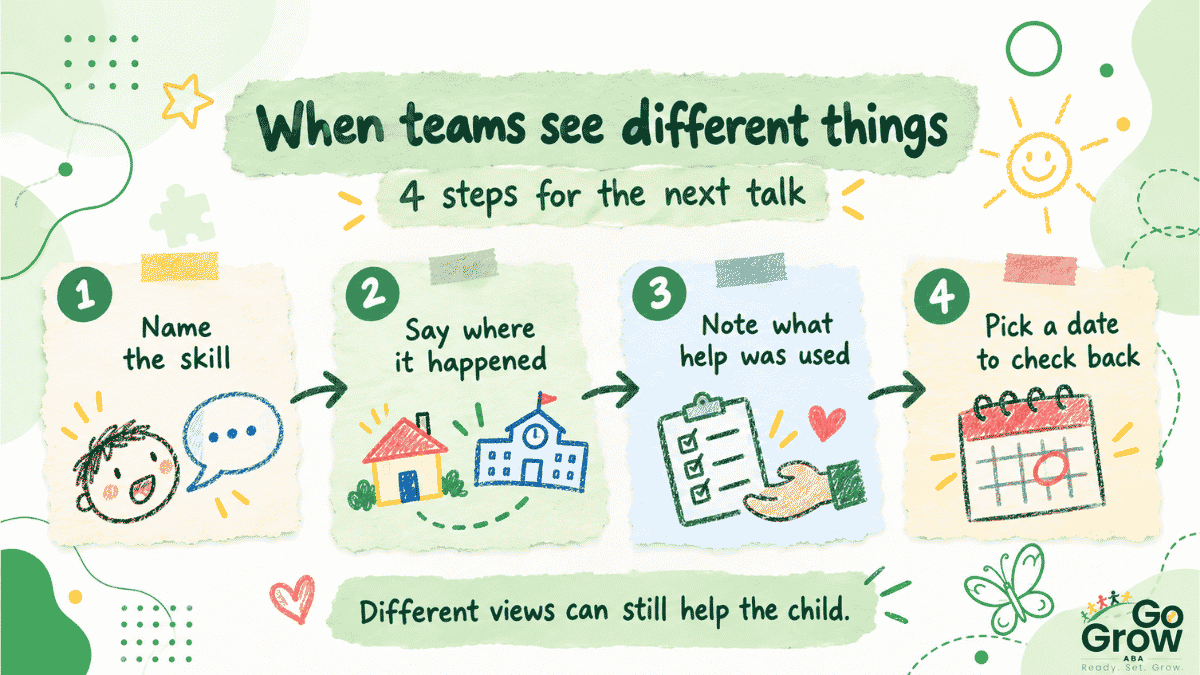
Different observations give the teams something to investigate. Classroom noise, group size, task demands, and adult support may differ from home sessions.
A follow-up conversation can focus on:
- The exact skill or concern each team observed.
- The support used in each setting.
- The information needed before changing a plan.
- One contact on each team and a date to review updates.
A monthly check-in is not a universal requirement. The schedule should reflect the child’s needs and the purpose of the update.
When a district proposes or refuses changes involving evaluation, placement, or a free appropriate public education, prior written notice must explain the action and its reasons. Meeting notes do not replace that notice.
 FAQs About ABA Therapy and IEP Coordination
Should home and school use the same rewards?
Home and school do not need identical rewards. Each team can consider the child’s interests and the activity involved. A shared understanding of the skill and the child’s needs gives the discussion more value than matching every item.
Can I request an interpreter for an IEP meeting?
Parents can request an interpreter when needed to understand the meeting. IDEA requires schools to take steps that ensure parents understand the proceedings, including arranging interpretation for parents whose native language is not English.
Can private ABA continue after an IEP changes?
An IEP change does not automatically end private ABA. Continued treatment depends on the child’s clinical needs and applicable coverage or payment arrangements. The updated school plan gives the BCBA information to consider during the next treatment review.
Bring Home and School Support Into One Conversation
Your child’s teams need specific observations, agreed responsibilities, and a way to follow up. A focused conversation can help everyone understand where support is needed across the day.
At Go Grow ABA, we provide in-home ABA and support collaboration with schools. Families can contact us about their child’s treatment needs and school concerns through a consultation. The consultation is a conversation about services, separate from a formal ABA assessment.