
Key Points:
- Early signs of autism in toddlers can include limited gestures, little shared interest, and repetitive play.
- A missed milestone calls for follow-up but does not confirm autism.
- Public early intervention programs can evaluate developmental needs before a medical diagnosis, while an ABA assessment serves the separate purpose of treatment planning.
Early signs of autism in toddlers may appear when a child rarely points to share something, responds less to people, or repeats the same play actions. A pediatrician can help explain these patterns and decide whether screening or a specialist evaluation is needed.
An unchecked milestone does not tell you why a skill is missing. Your observations can start that conversation, and families can request developmental support while waiting for answers.
 Early Signs Beyond Speech Delays
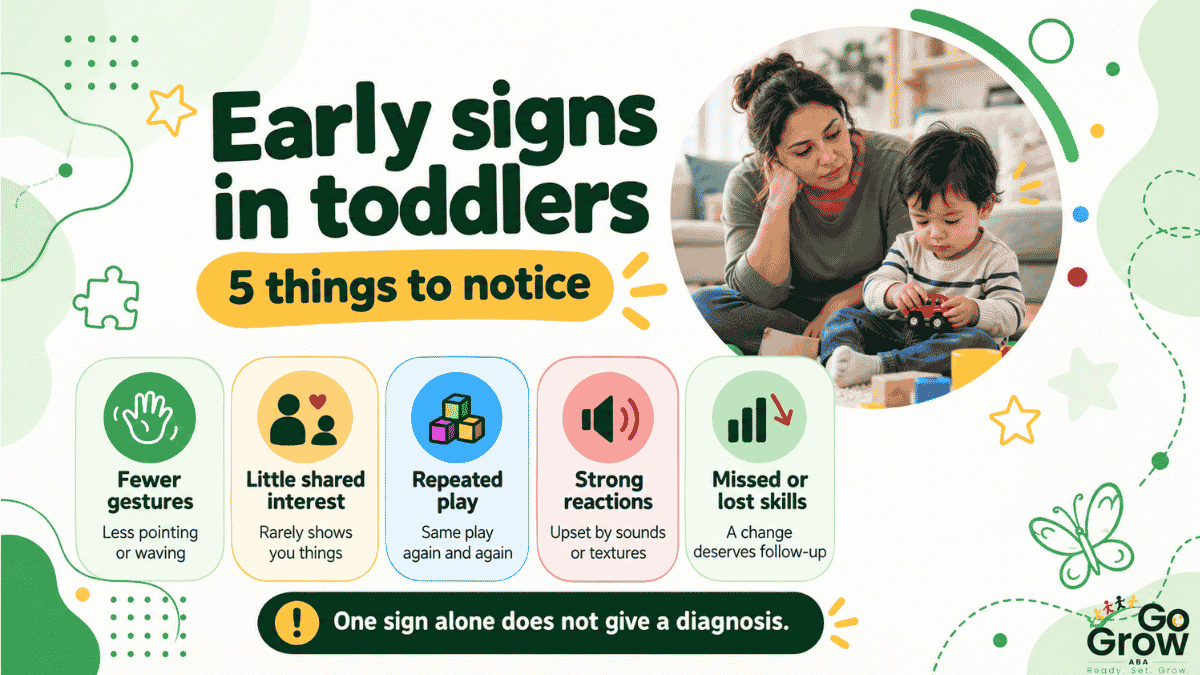
Autism signs can involve social communication, repeated behaviors, and responses to sounds or textures. The CDC’s autism signs and symptoms include patterns such as:
- Limited social responses: A child may respond less often to their name or use few gestures.
- Little shared interest: A toddler may rarely show someone a favorite object or point out something interesting.
- Repeated play or movements: A child may repeatedly spin toy wheels, line up objects, or rock their body.
- Strong reactions to change or sensations: Small changes, certain sounds, or clothing textures may cause distress.
Some children without autism show these behaviors, too. A single action cannot establish a diagnosis.
Shared interest means enjoying something with another person. For example, reaching for a snack requests something, while pointing toward a passing dog may invite someone to notice it together.
Developmental Milestones at 12, 18, and 24 Months
Milestones describe skills most children reach by a particular age. The examples below come from CDC checklists and focus on communication, interaction, and play. They are developmental reference points, not an autism test.
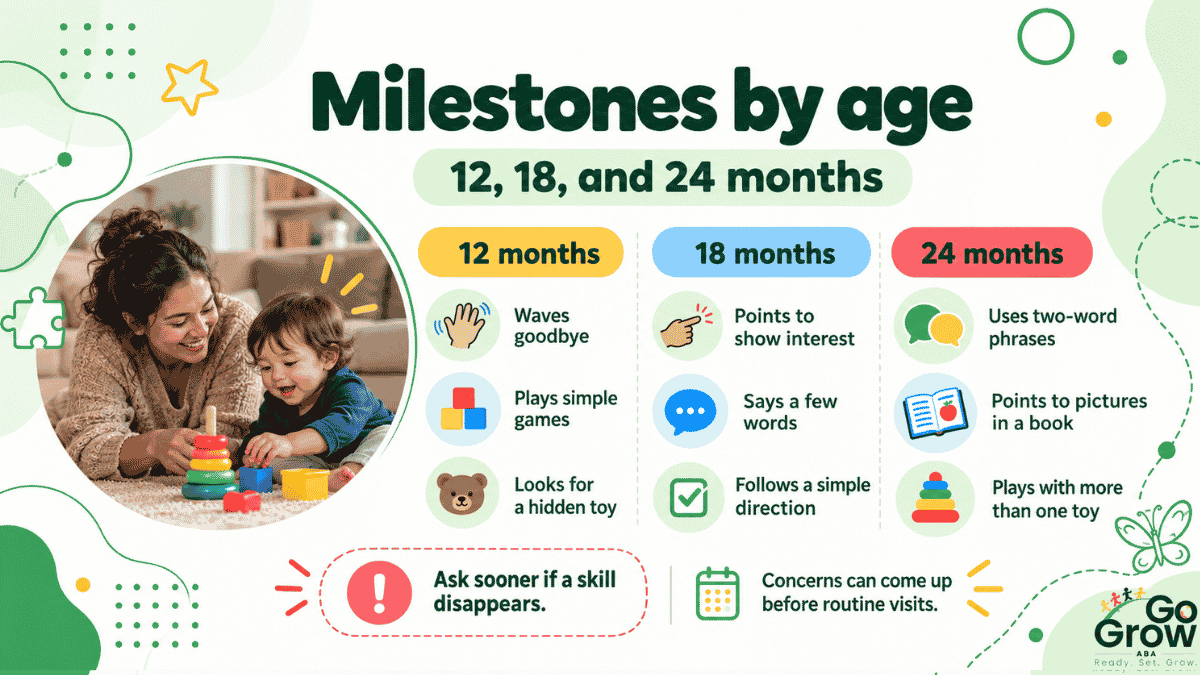
By 12 Months
The CDC’s 1-year milestone checklist includes:
- Games with another person, such as pat-a-cake.
- A wave goodbye.
- A special name for a parent, such as “mama” or “dada.”
- A brief pause or stop after hearing “no.”
- A search for something the child watched someone hide, such as a toy under a blanket.
By 18 Months
The CDC’s 18-month milestones include:
- Pointing to show something interesting.
- A look back toward a caregiver after moving away.
- Time looking at a few book pages with another person.
- Attempts to say three or more words besides “mama” or “dada.”
- A response to a one-step direction without an accompanying gesture.
- Simple toy play, such as pushing a toy car.
- Copies of everyday actions, such as sweeping.
By 24 Months
The CDC’s 2-year milestone checklist includes:
- Two words together, such as a request for more milk.
- Pointing to a picture in a book when someone asks about it.
- Pointing to at least two body parts when asked.
- Gestures beyond waving and pointing, such as nodding.
- A look toward a caregiver’s face to understand a new situation.
- Awareness that someone else is hurt or upset.
- Play involving more than one toy, such as putting toy food on a plate.
 When Should a Parent Request Screening?
A parent should request screening when a child misses a milestone, loses a previously learned skill, or shows another developmental concern. A missing skill does not need to remain absent for months before a family raises it with the pediatrician. Skill loss deserves prompt contact.
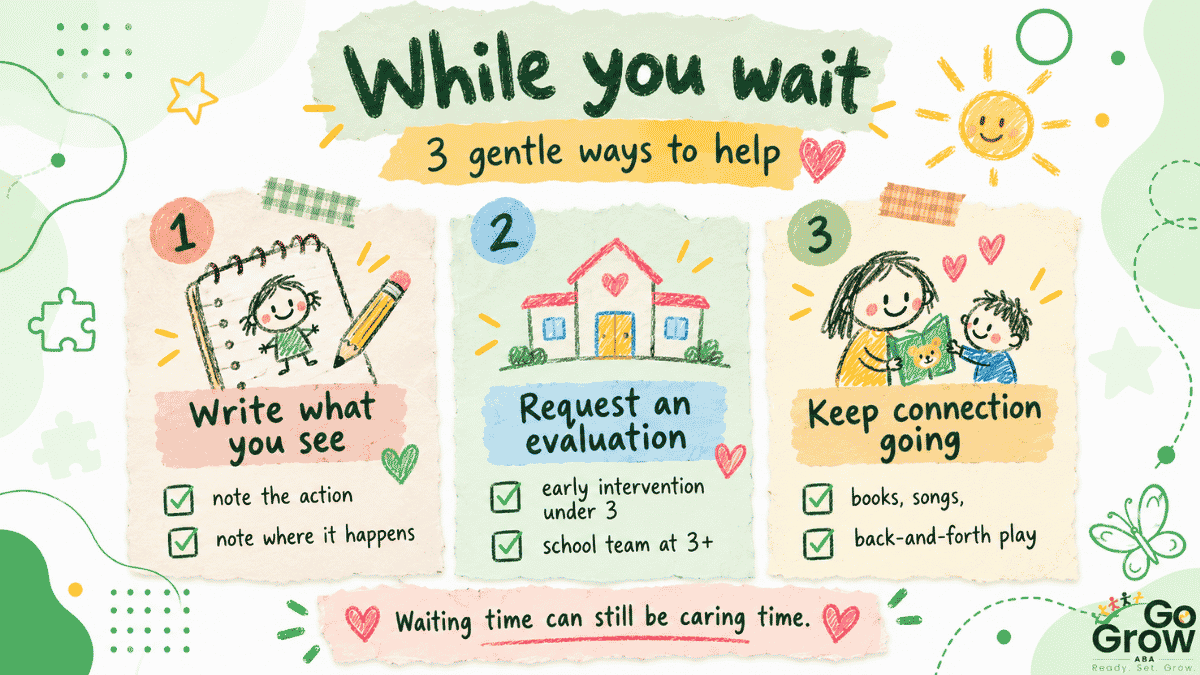
A few notes can help explain what happens at home:
- The action: “She reaches for things but rarely points to show us something.”
- The setting: The behavior happens during meals, play, or child care.
- The change: A word, gesture, or play skill appeared before but no longer does.
Your child’s strengths belong in those notes, too. Favorite games and ways of communicating help the doctor understand the whole picture.
Routine autism screening takes place at 18 and 24 months under American Academy of Pediatrics recommendations. General developmental screening follows a separate schedule at 9, 18, and 30 months. Concerns can lead to screening outside those visits.
Screening, Diagnosis, and ABA Assessment Have Different Purposes
A developmental concern starts a conversation. Screening helps identify whether a closer evaluation is needed, while diagnosis and treatment planning answer different questions.
| Step | What It Tells a Family |
|---|---|
| Developmental concern | A parent or provider notices a missing skill, lost skill, or behavior pattern that needs attention. |
| Developmental or autism screening | A formal tool identifies concerns that may need further evaluation. A result does not confirm autism. |
| Diagnostic evaluation | A qualified clinician reviews development, history, and behavior to determine whether the child meets criteria for autism or another condition. |
| ABA treatment assessment | A behavior analyst examines skills and support needs to develop treatment goals. It does not replace an autism diagnostic evaluation. |
The screening and diagnostic process involves more than completing a questionnaire. A diagnostic evaluation takes a deeper look at the child’s development.
At Go Grow ABA, our ABA assessments use observation, caregiver input, and skill assessment to develop treatment recommendations. These assessments help plan ABA care; a toddler milestone checklist cannot determine whether ABA is appropriate.
What Can Families Do While Waiting for a Diagnosis?
Families can request an early intervention evaluation while a diagnostic appointment is pending. A doctor’s referral or medical diagnosis is not required to contact the public early intervention system. Eligibility depends on the program’s evaluation.
The starting contact depends on the child’s location and age:
- New Jersey, younger than three: The New Jersey Early Intervention System accepts calls about developmental concerns at 888-653-4463. nj.gov
- Colorado, younger than three: Families can refer a child to Early Intervention Colorado online or call 833-733-3734.
- Age three or older: The local public school district can explain how to request an evaluation for preschool special education services.
An early intervention evaluation does not automatically enroll a child in private ABA. Our articles on early autism support in New Jersey and ABA for 2-year-olds explain those separate decisions.
Everyday connection can continue during the wait. Shared books, simple songs, and back-and-forth play offer ways to spend time together without turning each activity into a test.
 FAQs About Early Signs of Autism in Toddlers
Can hearing problems explain a limited response to speech?
Hearing differences can affect speech development and responses to spoken language. A pediatrician may recommend a hearing test alongside a speech-language evaluation to understand the child’s needs.
Does playing beside other children at age two suggest autism?
Playing beside other children is common at age two. Children this age are still learning to share and solve problems together, so side-by-side play alone does not identify autism.
What if the pediatrician offers reassurance but concerns continue?
A second opinion is reasonable when concerns remain. Families can request a referral to a developmental specialist or speech-language professional and explain which observations still worry them.
Talk With Our Team About ABA Intake
Your toddler’s communication, play, and everyday interactions can help a pediatrician understand your concerns. Screening, diagnostic evaluation, and early intervention each have a role in identifying the support your child needs.
At Go Grow ABA, we provide in-home ABA therapy, caregiver training, and treatment assessments. Our team can explain ABA intake and insurance steps while your family arranges the appropriate diagnostic evaluation.